
STORY BEHIND SUCCESS – EPISODE 1
From an asylum seeker to a Mayor of Frankfurt – the journey of determination – Interview with Mayoress of Frankfurt – Nargess Eskandari-Grünberg
STORY BEHIND SUCCESS – INTRO
In today’s world, we’re mostly shown the polished end result of success — the titles, the milestones, the recognition.
But those moments rarely explain how they were reached and offer little insight into what we can learn from them. Because what truly matters is the journey: the early choices, the quiet work, the failures, the doubts, and the people who shaped the path long before anyone was paying attention.
That’s where I believe the real lessons live. That’s where experience turns into something powerful. With this series, I want to show that there isn’t one single path to success — and that more often than not, it’s built through uncertainty, resilience, and lessons learned the hard way.
That’s where I believe the real lessons live — in the uncertainty, the quiet effort, the moments that don’t make headlines. It’s where experience turns into something powerful. With this series, I want to explore what unseen, often unexplained factors laid the foundation not just to persevere, but to succeed. Determination and resilience are part of it, I’m sure — but there’s so much more at play.
So now let’s learn from those who did succeed and are ready to share the narratives we often do not get to hear.
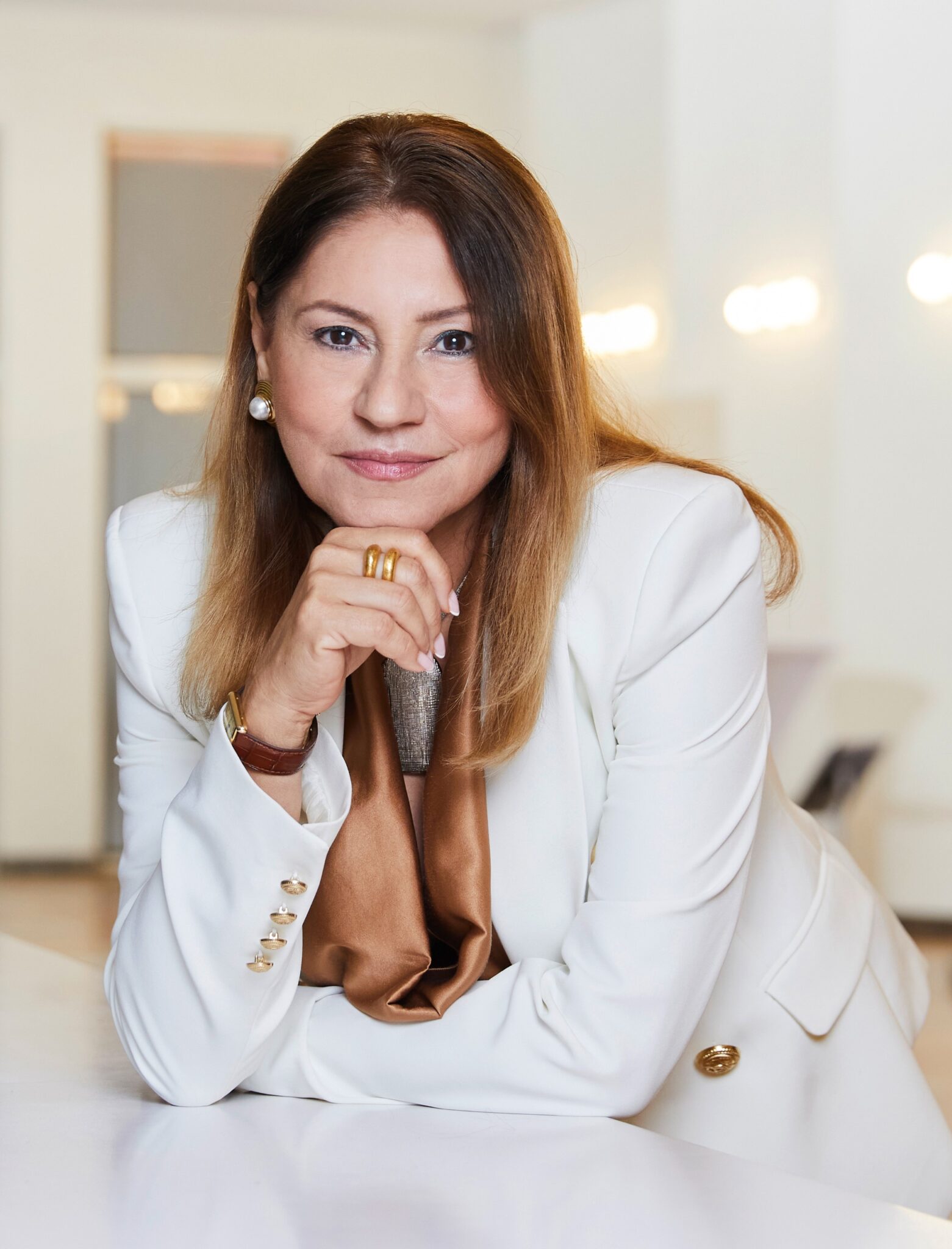
Today, I have the privilege of interviewing Nargess Eskandari-Grünberg, the Mayoress of Frankfurt, responsible for social cohesion, diversity, and anti-discrimination in one of Europe’s key financial centres — a city shaped by global business and a very international, multicultural population.
SUMMARY
Fleeing persecution in Iran, Eskandari-Grünberg arrived in Frankfurt on Christmas Eve with nothing but determination. Through relentless work, she built a life of freedom — for herself, her child, and ultimately, for the city she now leads as mayoress.
I would never want to take anything away from those who were born into privilege and are successful now. But what touches me most about Eskandari-Grünberg’s story is the journey—the metaphorical distance she traveled from where she started to where she ended up. I interviewed Eskandari-Grünberg in her office, where she shared parts of her life that are far from easy to recount. It felt like she was sharing more than her personal story; she was sharing a message that needs to be known.
Her story is not widely known. It’s not part of her campaigns, and she doesn’t use it to highlight how incredible her achievements are. It’s simply her story—one she mostly keeps private, a quiet testament to resilience and determination. And if determination could be personified, it would be Nargess Eskandari‑Grünberg.
Let me bring you her story…
THE STORY
IRAN
Her early life reads like a film script — but not one for the faint-hearted. Nargess Eskandari‑Grünberg was born in Tehran, Iran, during a time of political upheaval and social change. From an early age, she was shaped by a world where speaking up could be dangerous, but remaining silent was impossible. By her early teens, she was already drawn into activism, driven by a mix of curiosity, courage, and a refusal to accept injustice.
At fourteen, she found herself leading school strikes and demonstrations, convincing older students to follow her—even when the risks were real and terrifying. At 19, Eskandari-Grünberg was imprisoned in Iran for her political activism. It was there, behind bars, that she gave birth to her daughter, uncertain whether she would ever be free again. In that prison cell, a new priority took shape: her daughter would grow up in freedom.
That determination became her compass—guiding every decision, every risk, every step on the long path ahead.
About a year later, she was released. I can’t shake that image. It was snowing in Tehran, and the prisoners’ shoes had been confiscated upon arrival. Barefoot, she crossed the prison courtyard, snowflakes on her face, knowing she would finally see her daughter and family. Freedom was fragile — but real.
Almost immediately, she began planning a future beyond Iran. She knew she had to leave. She wanted to join an aunt in the United States and began organising the necessary paperwork. The route, however, led through Europe. The first direct flight was to Frankfurt.
FRANKFURT – THE BEGINNINGS
At the time, Frankfurt was simply a stop — a place to sort documents before moving on. She arrived on 24 December 1986, Christmas Eve. With her baby held close, she watched families gathering, celebrating, and belonging. She stood there alone, without knowing anyone, without the language, without a clear sense of what came next. The contrast was striking, almost unbearable.
There’s a saying: People make plans, and God laughs. What was meant to be a brief stop became a final destination. Her U.S. visa was rejected, and Eskandari found herself building a life for herself and her daughter in a city she didn’t know, with no network, no safety net — only determination.
She knew learning German would be key — but so would earning enough to support herself and her daughter. Eskandari-Grünberg threw herself into work without hesitation: cleaning, working at the post office — every job a step closer to where she needed to be. She worked ten-hour days, cared for her daughter, put her to bed, and studied German late into the night. On average, she got three to four hours of sleep.
LIGHT IN THE TUNNEL
Along the way, strangers became her support network: a neighbor she could trust to watch her daughter, colleagues offering a word of encouragement. Eskandari-Grünberg set her sights on studying psychology at Goethe University, one of Germany’s most respected institutions. After months of self-study, she took the entrance exam — and came in second.
Life was far from easy, but she was moving forward, and there was no turning back. She earned her doctorate, became a psychotherapist, and yet her curiosity kept pushing her beyond medicine. She began quietly in local community work, got elected to Frankfurt’s city parliament, and later became a deputy in the government, while still practicing as a psychiatrist. In 2008, she was invited to join the local government, a role she held for eight years alongside her professional work. Then, in the 2020–21 elections, the Green Party nominated her for mayor.
The Green party asked her to be more and more politically active, and she then got asked to become the Mayor. Now that we know the path and what Eskandari-Grünberg has put in to get there, I have even more respect than I had for her.
INTERVIEW
Inner Drive & Motivation
Q: Your journey has required incredible determination and resilience. Where does that inner drive come from?
A: It’s rooted in identity — part inheritance, part resistance. My parents gave me the foundation. My father, for example, could be paradoxical: he’d say, “You can’t do it,” but in the same breath, “I believe you can.” That tension pushed me to fight for my own choices. What stayed with me wasn’t just discipline — it was belief. To get strong, you have to keep fighting. You don’t give up on your goals, even when the world expects you to.
Q: Your story is emblematic of persistence. How did you stay motivated when the journey felt daunting?
A: I’ve always believed that determination shapes the path itself. As I like to say, “Where there’s a will, there’s a way” — “Wo der Wille ist, ist auch ein Weg.” Even when no path seems visible, taking consistent steps creates one. I think of it like climbing a mountain: when you reach a certain height, you can see that someone has been there before, and that gives you courage. Progress comes from action, even small steps, and the conviction that each step matters. Motivation isn’t a feeling; it’s a practice, built by walking the path you want to make.
Q: You’ve often been described as a natural spokesperson, even from a young age. How did that ability develop?
A: I think it always felt natural, even before I understood why people gravitated toward me. I was only fourteen when the revolution began, but I still remember marching into the school director’s office, grabbing the megaphone, and announcing that the entire school was going on strike. I decided—and they followed. When I think back, my classmates trusted me simply because I was… trustable. Even as the youngest in a circle of older, politically active friends, I wanted to learn. I begged my older cousins to let me sit in on their university classes. I was curious about the world, and I think that curiosity, combined with honesty, gave people confidence in me.
Overcoming Challenges & Resilience
Q: Your early years were marked by imprisonment and fear. How did you cope, and what kept you going?
A: Surviving prison meant finding ways to hold on to our humanity. The room was tiny, crowded with 80 people, sharing one bathroom. Many cellmates never made it out. We created small rituals — pretending to smoke, telling stories, supporting one another — just to survive. But my anchor was my daughter. Even in the darkest moments, I held on to the belief that she could grow up free.
When I was released, I hadn’t seen my reflection for over a year and I barely recognized myself. That moment became symbolic — a first taste of freedom and a chance to reclaim my life. Every step afterward — navigating bureaucracy, leaving my country, rebuilding — was guided by that clarity. Even in extreme circumstances, purpose and determination create a path. “Die Wege entstehen, indem du gehst” — the path is made by walking.
Q: Arriving in Germany, you were in a completely new world — no language, no plan, and no family around. What was that experience like, and what carried you through it?
A: It was overwhelming. I remember seeing families gathered for the holidays, lights in the windows, plates on the tables — while I stood alone, unsure if I’d ever see my own family again. It was one of the most emotional moments of my life. I had lost my loved ones, perhaps forever.
But alongside that grief, something else was stirring — a quiet, absolute force. I wanted to be free. Freedom became everything. The moment I stepped off that airplane, I felt it: nobody could arrest me, nobody could torture me. That feeling was more than relief — it was life itself. Democracy, I realized, isn’t just an abstract idea; it’s oxygen. That clarity shaped everything I did after, giving me the courage and focus to build a life from nothing.
Q: Your arrival in Frankfurt was unplanned, a detour rather than a destination. How did you turn that unexpected stop into a new beginning?
A: Frankfurt was never meant to be home — it was just a stop on the way to America. I threw myself into work, taking any job I could find, knowing that I had to keep moving forward.
Looking back, that period taught me that resilience isn’t about never feeling fear; it’s about taking steps despite it. It’s about building a life when nothing seems possible, and seeing detours as opportunities rather than obstacles. Frankfurt became more than a stop — it became the city where I learned that purpose, courage, and persistence shape a life, and that leadership starts not with titles, but with action, trust, and the choices you make every day.
Q: When you first arrived in Germany, your goal was clear — to give your daughter a future — but the obstacles were immense. How did you navigate that early period of uncertainty?
A: It felt almost impossible. I was twenty, with no language, no resources, and a dream of America that never came true — the visa was denied. Being a refugee then was very different: no language classes, no right to work, no independent housing. I lived in a camp where I didn’t feel safe. When I got sick, authorities let me move into an apartment — but only if I paid for it, even though I couldn’t legally earn money.
Eventually, I received a limited work permit. I cleaned in a hospital and, with a neighbor’s help, worked as a typist for a newspaper. What I learned during that time — and what I tell others — is that when times are hard, people you never knew can become key in your story. Let them in. Accept help, trust small acts of kindness, and you’ll see how much they can shape the path ahead.
Q: You’ve spoken openly about facing discrimination, even as you were building a life in Frankfurt. How did that affect your sense of belonging?
A: As a foreigner, you’re constantly fighting inside. There’s always the question of whether you truly belong. But over time, Frankfurt became my city. It’s my home. It’s the place that gave me a chance — and gave my daughter a chance. That doesn’t mean the path was easy. Every step felt like pushing through another barrier, another reminder of how fragile belonging can be. But precisely because of that, I learned something important: belonging isn’t given, it’s built — step by step, through perseverance, contribution, and claiming your place.
Q: You were raising a child while studying and later building a career, often under intense pressure. How did you manage those competing responsibilities?
A: It was relentless. I had to learn to do everything at once because there was no alternative. Before arriving in Germany, I had never cooked; suddenly I had a child, a degree to pursue, bills to pay, and an entire life to rebuild. What helped me was clarity. I had my priorities, and as long as they were clear, I could manage.
Money was always measured carefully — what could stretch and what couldn’t. I remember one Christmas vividly. My daughter wanted rollerblades, something I couldn’t really afford. At the post office, a heavy box fell on my foot. I was in pain, but I stayed and worked three more hours because I needed the extra pay. I limped through the shift just to buy those rollerblades. It was worth it. She was happy — and that was my goal. That discipline wasn’t just about survival; it taught me structure, responsibility, and focus. Looking back, it shaped the way I work to this day: when your priorities are clear, even the heaviest load becomes manageable.
Q: When you look back on your journey, who were the people who helped shape your resilience along the way?
A: The first person I think of is my aunt. She was a steady voice through every setback, always repeating the same message: believe in yourself, don’t give up when things get difficult, and surround yourself with people who lift you rather than hold you down. That advice stayed with me.
Even today, I sometimes return to Frankfurt Hauptbahnhof just to stand there and remember where it all began. My aunt used to tell me to picture myself at the train station and then look at how far I’ve come. It became a ritual of perspective — a reminder that resilience, consistency, and belief can carry you a long way, even when you start with nothing.
Legacy
Q: When you think about the legacy you hope to leave behind, what matters most to you?
A: First and foremost, values. Never forget them, and never compromise them. Power has a way of shaping people if they allow it, and that’s dangerous. You have to shape success — not let success shape you. Dignity and decency are non-negotiable, especially in leadership.
The second is focus. Life is full of noise. If you know your goal, concentrate on it. Don’t look back, and don’t look to the sides. Stay fixed on what matters, and you will manage.
And finally, the people around you. No one achieves anything alone. You need people who believe in you, who share the journey, and who stay when things get hard. For me, community was never abstract — it was survival, momentum, and belonging. These three pillars — values, clarity of purpose, and the right people — are what I carry into leadership, and what I hope others will hold onto long after my story is told.
I hope this story has inspired you as much as it has inspired me. When I heard it, I simply couldn’t keep it just for myself. This is the first of a series of interviews to inspire curiosity, courage, and the drive to create your own path — one story at a time.
Yours,
Marta